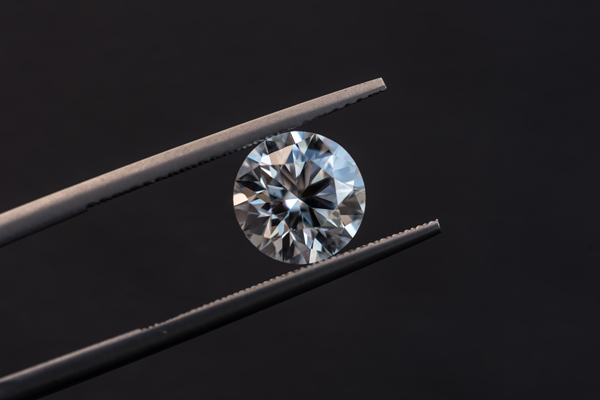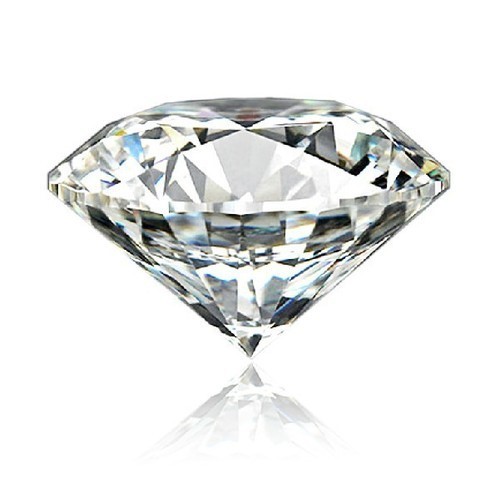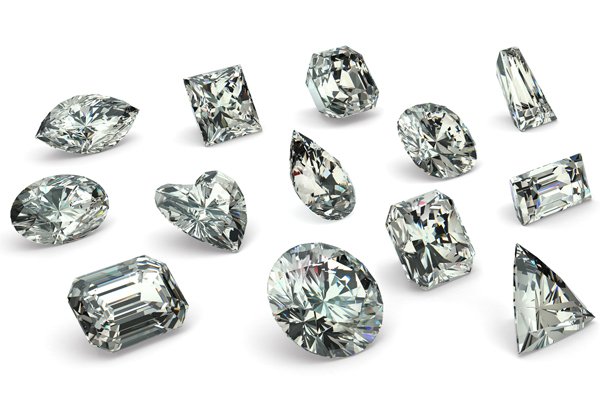
There are basically three types of cutting patterns, the brilliant
cut, the step cut and the mixed cut (a combination of brilliant
and step cuts). Sometimes diamonds with modified cuts are described
both as to shape and faceting pattern in order to minimize confusion.
For example, an oval shaped stone, which has a brilliant cut crown
and a step cut pavilion, might be referred to as a "modified oval"
or an "oval mixed cut".
Some of the fancy shapes are better suited for retaining the maximum
weight of the more flat forms of diamond rough called macles and
flats, and many are also cut from the less perfectly shaped octahedral
and dodecahedral crystals. There are many other shapes (trilliant,
bagette, etc.) and many branded cutting patterns which occupy specialized
niches and more limited market positions, but we will not cover
them here.
Factors important in selecting a fancy shaped diamond include
all of the 4C's as they apply to the round shape. However, additional
considerations come into play when considering fancy shapes such
as the overall appearance of the outline of the girdle of the stone,
the "bow tie" effect and the length-to-width ratio. Finally, one
may ask, how does shape affect price? So here we will consider each
shape separately and the factors which are important in how they
impact beauty and price.
Currently there is no widely accepted "ideal" range of proportions
for the fancy shaped diamonds. However, these may be developed in
the future because it is known that the American Gem Society is
working on this issue (see www.gemappraisers.com for details. This
is probably the best classification of cut proportions in fancy
shapes currently available.)
When looking at the general appearance of fancy cut diamonds,
make sure that the stone is appealing to your eye and that it is
bilaterally symmetrical. In other words, if you draw an imaginary
line down its center length or across its width (excluding heart
and pear in the latter case), one half of the stones should be shaped
exactly as the other half. Also look at the shape of the pavilion,
especially on emerald cuts, from all angles to make sure it isn't
too deep and doesn't bulge excessively, an indication of extra weight
retention and perhaps a reduction in light return (brilliance).
In many fancy shaped diamonds (marquise, pear, oval, emerald and
heart shapes) the pavilion facets do not culminate at a point at
the tip of the pavilion, but rather form an edge, called the "keel
line". However, for grading purposes this is still referred to as
the culet and should be judged accordingly.
Girdle width will vary between greater extremes on some
fancy shapes compared to the round brilliant. These include the
marquise, pear and heart, where the girdle tends to be thick or
extremely thick at the tips of the stone and in the cleft of the
heart-shaped cut. Also, the princess cut, which has square corners,
may have an extremely thin girdle in these areas. These situations
are frequently encountered with fancy shapes, and attention needs
to be paid to the potential problems of excessive weight vs. danger
of cracking or chipping in diamonds with extremely thick or extremely
thin girdles, respectively.
The length-to-width ratio is important to a stone's appearance,
and for the marquise shape the preferred range is 1.75-2.25: 1.00.
Marquise diamonds frequently show a bow tie, so try to find a stone
in which this is minimal or absent. This shape of diamond in a ring
accentuates the length of the fingers.
As a % of the diamond's width, the better cut marquise will have
table % in the range of 53-63% and total depth % (crown+girdle+pavilion)
of about 58-65%.
The cost of a 1ct., D, IF marquise is about 20% less than that
of an identical round diamond. For a 1ct., G, VS2 stone, the marquise
cut is only about 7% cheaper than the same round diamond.
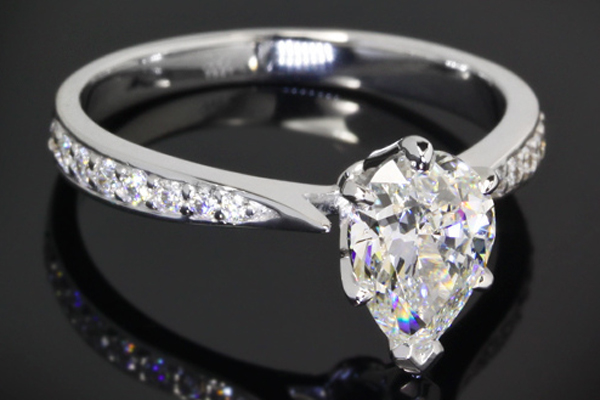
PEAR - The pear shape, like the marquise, usually has the
58 facet brilliant pattern, but can also be cut with different numbers
of pavilion mains of 8,7,6 or 4 facets.
In a pear, look for a well-shaped head and even shoulders with
an optimal length-to-width range of 1.50-1.75:1.00. This shape in
a ring will make the fingers appear longer. Pear-shaped diamonds
work equally well as pendants and are exceptional as drop earrings.
Ranges for the well cut pears for table % and total depth % are
about 53-63% and 58-65%, respectively.
The relative cost of a 1ct., D, IF pear shaped diamond is roughly
25% less than an identical round stone, but a 1ct., G, VS2 pear
is only 20% less than the cost of an identical round.
OVAL - The oval, as with the above examples, is seen most
frequently cut in the standard 58 facet brilliant pattern, but again
can have a varying number of pavilion mains facets ranging from
4, 6 or 8.
For ovals, look for even, well-rounded ends with a full body having
an optimal length-to-width range of 1.33-1.66: 1.00. This shape
of stone in a ring accents finger length, and also works nicely
as stud earrings.
Higher cut quality ovals, as with the marquise and pear, have
table %'s of about 53- 63% and total depth %'s of 58-65%.
The relative cost of an oval diamond of 1ct., D color and IF clarity
is roughly 25% less than an identical round stone, but a 1ct., G,
VS2 oval is only 20% less than the cost of an identical round.
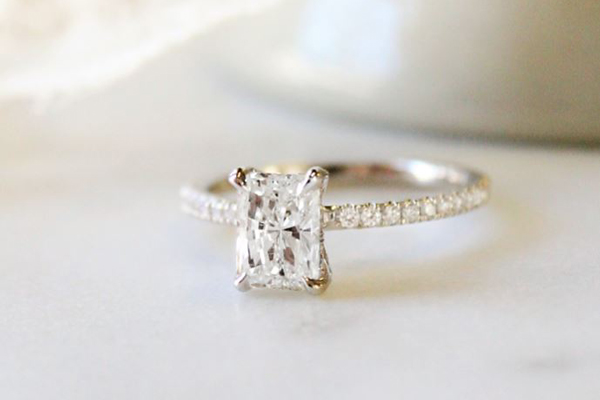
RADIANT - The radiant cut is a patented name and cut called
a cut-cornered, square/rectangular (depending on the overall shape)
modified brilliant on GIA grading reports. It has a total of 70
facets, there being 25 crown, 8 girdle and 37 pavilion facets. The
truncated corners may aid in avoiding or minimizing possible chipping
problems posed by extremely thin girdle widths in these areas of
the stone.
Generally, a ring with a square cut radiant tends to shorten the
appearance of the longer fingered hand.
Radiants of higher cut quality will have table %'s of about 59-69%
and total depth %'s ranging from about 59-69%. Deep pavilions are
often seen on many radiants and princess cuts and contribute to
the increased total depth % seen in these stones. However, this
extra depth is often necessary to bring out the maximum brilliance
in the stone.
The comparative cost of a 1ct., D, IF radiant diamond is roughly
33% less than an identical round stone, but a 1ct., G, VS2 radiant
is only about 20% less than the cost of an identical round.
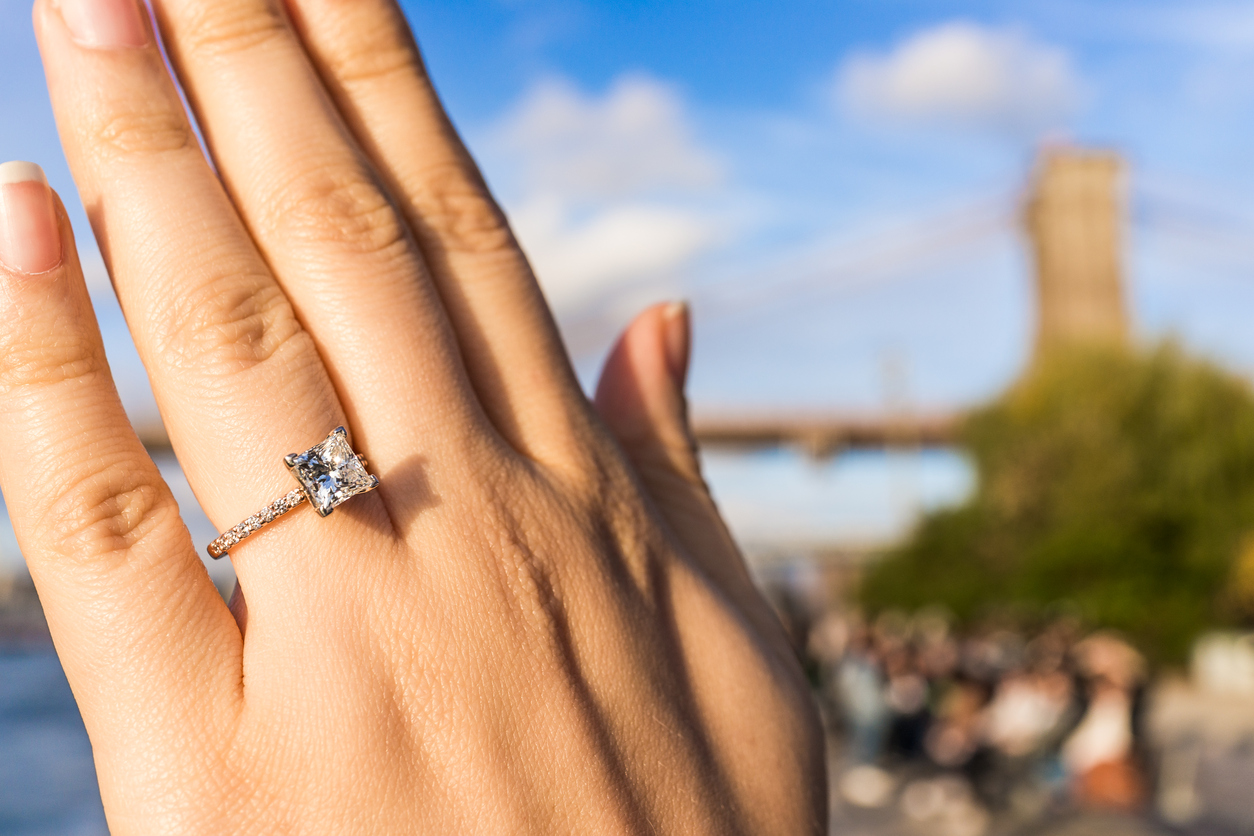
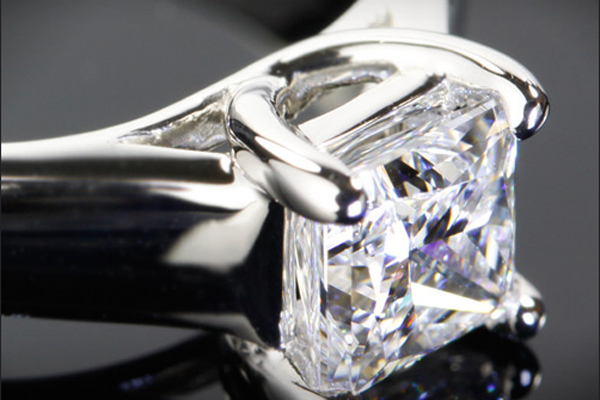
PRINCESS - The princess cut is called a square/rectangular
modified brilliant in GIA grading reports. It may have either 50
facets (21 crown, 4 girdle, 25 pavilion) or 58 facets (21 crown,
4 girdle, 33 pavilion), depending on how the pavilion is cut.
This cut of diamond is frequently a square shape and therefore
shortens the appearance of the longer fingered hand. The princess
cut has sharp, squared-off corners, and if the girdle is extremely
thin in these areas, chipping or cracking may occur more easily.
Princess shapes of high cut quality usually have a table % in
the range of roughly 60-75% and a total depth % of about 65-80%.
As with the radiant, the cost of a 1ct., D, IF princess diamond
is roughly 33% less than that of an identical round stone, but a
1ct., G, VS2 princess is only about 20% less than the cost of an
identical round.
EMERALD - The emerald cut is not a brilliant cut, but is
called a step cut. Step cuts are comprised of larger, planar facets
which act like mirrors. The emerald cut has 58 facets, with 25 crown,
8 girdle and 25 pavilion. Because of the angle, size and shape of
the facets, the emerald cut shows less brilliance and fire (dispersion)
than the other brilliant and modified brilliant cut diamonds. However,
the emerald cut stone reveals a classic and aristocratic elegance
and beauty not seen in other cuts.
Because of the open and large, plate-like nature of the facets,
it is highly recommended that you consider staying at higher color
(D-G) and clarity (IF-VS2) grades than you might with a brilliant
cut stone because they are more likely to become visible at lower
grades. Also, check to make sure that all the facet edges appear
parallel in the face-up position. If they aren't, it can be pretty
obvious at times.
The emerald cut offers a touch of regal elegance as the center
stone in a ring, and the most attractive proportions are a length-to-width
ratio range of 1.50-1.75:1.00. However, some prefer a more square
look with a ratio in the range of 1.30:1.00. Obviously, the more
square the shape, the more it compliments the longer-fingered hand,
and the more rectangular, the better suited it is to the shorter-fingered
hand.
The better emerald cut diamonds, like radiants, will have table
%'s of about 59-69% and total depth %'s ranging from about 59-69%.
Like both the radiant and princess, the cost of a 1ct., D, IF
emerald cut diamond is roughly 33% less than that of an identical
round stone, but a 1ct., G, VS2 emerald is only about 20% less than
the cost of an identical round.
HEART - The heart shape is a brilliant cut, which can also
be modified so that the number of pavilion mains may be 6, 7 or
8.
In a heart cut it is important to look for a perfectly symmetrical
appearance where the lobes (top arches) are of even height and breadth,
and the overall shape pleasing.
The better cut heart shapes will have a length-to-width ratio
of just about 1.00:1.00, with a little variation from about 0.98:1.00
to 1.02:1.00.
This shape is seen frequently in pendants, but is suitable for
most any purpose.
The well-cut heart shaped diamonds will have a table % in the
53-63% range, and a total depth of about 58-65%.
Roughly comparable with the pear and oval shapes, the relative
cost of a 1ct., D, IF, heart shaped diamond is approximately 25%
less than an identical round stone, but a 1ct., G, VS heart is only
about 20% less than the cost of an identical round diamond.