
This article has mentions of products from one or more companies, and I may receive compensation if you purchase those products following reading my recommendations.
A high-quality diamond is a product of Mother Nature’s elements perfectly balanced; carbon levels, heat, and pressure—all must be united in perfect harmony to create a natural diamond.
Clarity refers to the unique ‘birthmarks’ or tiny imperfections encapsulated within the diamond and on its surface. These fragments are known as ‘inclusions’ when featured internally and ‘blemishes’ when they rest upon the surface. The overall value of a diamond is determined by the absence of these imperfections, amongst other things.
Both inclusions and blemishes influence how an individual diamond’s clarity is graded. Clarity itself comes in a variety of gradings, with the very best grades known as ‘Flawless’ and ‘Internally Flawless’. These are some of the most expensive diamonds to be found on the market. Other diamond clarity grades, such as VVS1, VVS2, and VS1 and VS2, are just as popular but come at a lower price.
In this section, you will be able to find out all you need to know about diamond clarity. Use the diamond clarity chart below to aid you when purchasing the diamond of your dreams.
- Diamond Clarity Explained
- Types of Inclusions
- The Diamond Clarity Chart
- How Are Diamonds Graded?
- What Else Does a Grading Include?
Diamond Clarity Explained
Diamond clarity is the metric used across the diamond and jewelry world to ascertain and grade the respective quality of a diamond’s visual appearance. You can think of it as determining the visual purity of a diamond—as the number of blemishes increases, the relative impact and value of the diamond decreases.
However, it’s worth noting that the vast majority of diamonds contain inclusions. These are naturally-occurring gemstones, and are subject to millions of years of external pressures and environmental strains. The fortunate reality is that most of these inclusions are infinitesimally small, far too small to be seen by the naked eye.
Types of Inclusions
Inclusions in a diamond are subcategorized and identified by their unique visual properties and their effects on the overall appearance of the stone. The most common of these are small black carbon fragments that appear in a spotted formation, which gives the impression of dirt within the diamond.
While there are numerous examples of unique flaws within the gemstone, some feature more regularly and thus more likely to influence you when choosing the perfect diamond. For example, you may come across diamonds that have:
- Knotting: Knotting refers to the extensions of diamond crystals towards the surface of the stone. Visible to both the naked eye and beneath a jeweler’s loupe, knots can present raised points on the diamond, as well as compromise the structure of the stone.
- Feathering: Feathers are a light inclusion of cracks or fissures that give a feather-like appearance. If they appear close to the surface of a diamond they can affect durability and longevity, particularly when set in a regularly worn ring.
- Needles: Perhaps the most visible of all inclusions, needles appear exactly as they sound. Often black, these long thin lines can be clearly seen throughout a diamond, defined in both color and shape. When needles gather the effect can be striking, a rare and beautiful sight, however regular needles impact on the sparkle and light return of the diamond.
- Pinpoint: Tiny white crystals form within the diamond. While these rarely affect the clarity of a diamond and are not often mentioned in grading reports, the presence of three or more of these little white lights is referred to as clouding, and can give a hazy, unclear appearance to a diamond, detracting from its natural luster.
- Graining: This is a type of inclusion that presents white, reflective, or colorful internal lines that form due to irregular crystal growth. While potentially interesting from a geological point of view, they can give the diamond a hazy appearance.
- Cavity: A cavity is a crack or dent present in the surface of a diamond. Depending upon the minerals that may be present within the body of a diamond, cavities can be colored or colorless. A colored cavity will always be much more noticeable.
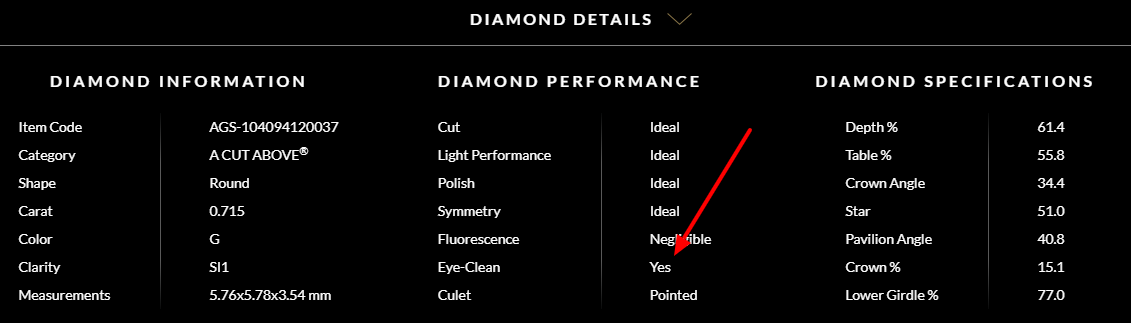
Reputable diamond companies will only stock diamonds from SI2 and above. This is because inclusions that are seen by the naked eye are thought of as low quality, which diamonds below SI2 are much more likely to have. If you are looking to purchase a diamond that is SI1 or SI2, look for an "eye clean" mark or stamp, like the below image from Whiteflash.
The Diamond Clarity Chart
It’s incredibly rare to find a diamond that is completely blemish and inclusion free. The entirely natural formation of this stone is part of what makes it covetable, rare and valuable. However, the absence of visible inclusions has a huge impact on the beauty and value of a diamond. To determine the quality of an individual diamond, the GIA and AGS have created detailed scales to create international uniformity when assessing diamond clarity.
You can see a distillation of these detailed scales in this diamond clarity chart. Charts like these are used to judge a respective diamond on its appearance, which then results in a clarity grade being assigned to that diamond.
Diamond clarity charts usually range from FL (Flawless) to I2 (Included 2), with the former being the top quality grading. They’re very useful for beginners who are purchasing diamonds online.
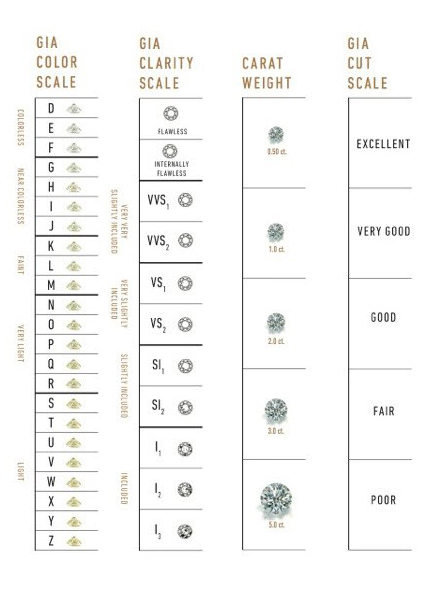
A Comparison of GIA and AGS clarity scales.
How Are Diamonds Graded?
Diamonds are graded by industry experts, such as the GIA or the AGS. Grading itself is done through a complex and sometimes laborious process that includes the detailed analysis of an individual diamond and cross-referencing what is discovered with a number of industry-wide standards.
Those who grade diamonds will be analyzing the diamonds in relation to five factors: size, nature, number, location, and relief.
-
Size
The size of inclusions is considered a serious potential impact on the appearance and light performance of a diamond. A stone might only have one inclusion, but if it's huge, the diamond will suffer.
-
Nature
When we talk of the nature of an inclusion, we’re talking about its type (cavity, feathering, etc.), how deep it is within the diamond, and whether it is an inclusion or if it is a blemish.
-
Number
The grader will also be documenting the actual quantity of inclusions or blemishes present. Remember, the more inclusions or blemishes, the more likely these will have an impact on the quality and performance of a diamond.
-
Location
Location affects how noticeable an inclusion is to the naked eye. If the inclusion is closer to the girdle, it’s most likely harder to see. In contrast, if an inclusion sits in close proximity to the center of the table, it’s easier to see.
-
Relief
Relief refers to the overall contrast to be seen between an inclusion or blemish and the diamond it sits upon. A high relief means the contrast is large, which necessitates an inclusion that’s much easier to spot.
What Else Does a Grading Include?
Alongside its clarity grade, a certified stone will often come with a ‘map’ of its unique inclusions and their placements within the diamond, such as the one below. Studying your jewel beneath a loupe and identifying these marks and blemishes can be an excellent way to broaden your understanding of diamond clarity.
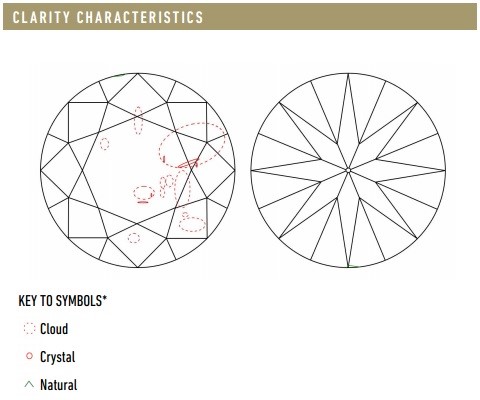
Example of GIA diamond mapping.
Clarity is perhaps the most tangible of the four Cs and has the greatest impact on the structural durability of your diamond. Armed with the knowledge of inclusions and their appearances you can be sure that you choose a stone that will truly last an eternity.
Do continue to read on and find out how the other Cs make a diamond beautiful: Cut, Color, and Carat.